


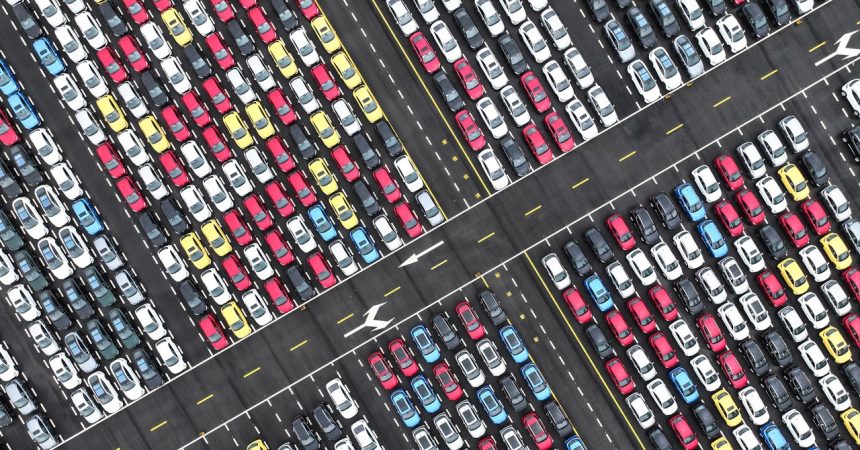
After officially hiking tariffs on Chinese electric vehicle imports earlier this month, the US government is getting even more serious about keeping China-made autos out of the country. On Monday, the US Commerce Department proposed a new rule that would ban some Chinese- and Russian-made automotive hardware and software from the US, with software restrictions starting as early as 2026.
The Biden administration says the move is needed for national security reasons, given how central technology is to today’s increasingly sophisticated cars. In announcing the proposed ban, Commerce Secretary Gina Raimondo cited vehicles’ internet-connected cameras, microphones, and GPS equipment. “It doesn’t take much imagination to understand how a foreign adversary with access to this information could pose a serious risk to both our national security and the privacy of US citizens,” she said.
The US government’s move comes as China has dramatically increased the number of affordable vehicles, and especially electric ones, it makes and sells overseas. Chinese auto exports grew by more than 30 percent in just the first half of this year, setting off alarm bells in Europe and the US, where officials worry inexpensively made Chinese vehicles could overwhelm domestic industry. The US and Europe had moved to make it harder and more expensive for China to sell its autos in those regions, but the Chinese automakers have responded by setting up manufacturing bases in Eastern Europe, Africa, and Mexico—all of which might one day provide a loophole to allow more Chinese-designed and engineered vehicles into new Western markets.
Still, the proposed rule focuses on security rather than competition. Raimondo had previously raised the specter of foreign actors using hijacked connected car technology to cause mayhem on the US public roads. “Imagine if there were thousands or hundreds of thousands of Chinese connected vehicles on American roads that could be immediately and simultaneously disabled by somebody in Beijing,” she said in February.
That situation isn’t quite realistic, given how few Chinese and Russian firms supply automotive software or hardware in the US right now. A proposed software and hardware ban is more preemptive than a response to any immediate security risk, says Steve Man, the global head of auto research at Bloomberg Intelligence, a research and advisory firm. “PRC and Russian automakers do not currently play a significant role in the US auto market, and US drivers right now are safe,” a senior Biden administration official told WIRED.
Because the rule would apply to any connected vehicle, not just electric ones, it would create even stronger prohibitions against Chinese-made auto tech. “If the 100 percent tariffs on made-in-China EVs were a wall, the proposed ban on connected vehicles would be a death sentence for China EV Inc. aiming to enter the US,” says Lei Xing, the former chief editor at China Auto Review and an independent analyst. Under such a rule, he says, the prospects of seeing Chinese EVs on sale in the US in the coming decade is “nearly zero.”
Read the full article here