

For what could be the first time in history, an advertiser may soon be able to fix that pesky pothole at the end of the block. At least if you live in District 19 in Dutchess County, New York, that is.
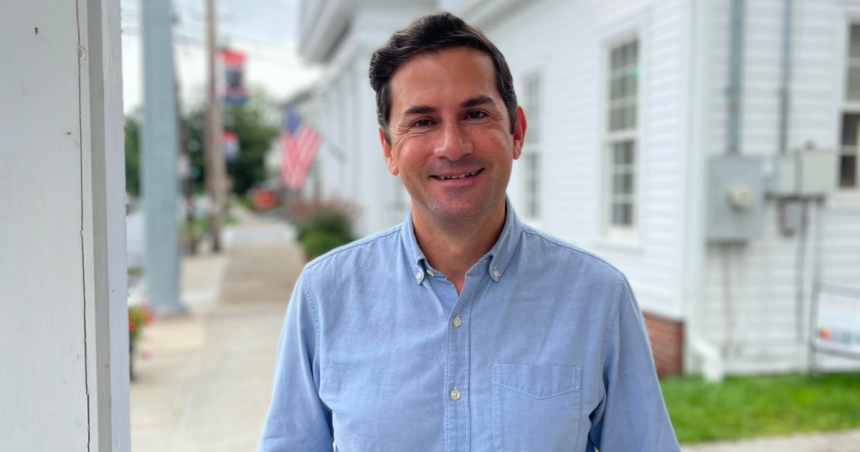
Chris Drago, a marketing and advertising veteran who worked as head of global media and digital marketing at Hewlett Packard Enterprise before leading marketing teams at Mailchimp and Airtable, now represents nearly 11,000 people. Drago, a Democrat, beat out five-term Republican incumbent Gregg Pulver in November, winning a district that’s about 170 square miles. Marketing Brew spoke with the newly elected Dutchess County Legislator about what it was like to run for office, his strategy, and what it was like to work with Facebook’s advertising tools.
When did you decide to run for office?
Almost a year ago, probably February. I went around and met with all the town Democratic committees to express my interest, to learn more about the role, and to see if they’re interested in me. Out of that process, they all said, “Yes, we think you’re great, and we think you have a chance of winning, [but] that this was not going to be easy because [Pulver] is entrenched. He’s been doing this for a while.”
How large was your budget?
For the primary through the general election, I knew I needed to raise around $20,000 to $25,000, because I looked at what had been spent previously by the incumbent in other campaigns. I also knew I was going to have to spend more because [Pulver] is an incumbent, and he’s more well-known in the area than me. Even though I did grow up here, and I am known, he was more of a known quantity.
All said and done, I ended up raising over $30,000 and outraised my opponent in the general election over three-to-one.
Did you invest in advertising to fundraise?
Yes. We invested in boosting social in the primary and in the general election. We printed [and sent] mailers.
For the general election, I created a video ad: A 15-second spot with my brother-in-law’s camera, and we boosted that on programmatic [channels] and YouTube. I worked through a buddy of mine who’s running his own CTV programmatic video shop. Through him, I was able to spend less than $2,000 and get town-[level] targeting and be on TV, as well as YouTube, in a targeted way.
How did you apply your media skills and experience to a political campaign?
Given the fragmented media landscape in our part of the county, I knew digital was probably one of the best ways I had to get in front of people who didn’t have an awareness of who I was and what I stand for.
It just became so apparent when I was running this campaign—the reality that there’s not a single, trusted source of news where I live. And that’s true for a lot of parts of the country…I knew there wasn’t going to be a one-stop shop. I had to find multiple ways of getting in front of people, given the fact that they’re all not looking at the same thing all at once. Digital was definitely the way to do that.
What channels did you invest in, specifically?
Primarily Instagram and Facebook. For the general campaign, it was YouTube and some of the programmatic CTV platforms.
Did you also invest in Facebook and Instagram for the general campaign?
Yeah, and it was funny. Leading up to the general, my Facebook account got hacked. Maybe three or four weeks out from the general, I had no access to be able to boost Facebook or Instagram ads. After a fairly frustrating couple of weeks, I finally was able to get access back. Not having a helpline at Facebook to call and ask someone to help me out, not being able to rely on a big agency partner, it was me having to do it by myself; it was very frustrating. But I actually learned a lot through the process.
Get marketing news you’ll actually want to read
Marketing Brew informs marketing pros of the latest on brand strategy, social media, and ad tech via our weekday newsletter, virtual events, marketing conferences, and digital guides.
Given my career, I had never been a hands-on-keyboard person. I’d always managed a team that was doing that work. It was really humbling and actually very informative for me to actually be in platform doing that level of work. Honestly, when I go back into the media space, I think I’ll be that much smarter now having had this experience.
Walk me through the process. How does political targeting work?
So, one, you’ve got to get approved to run political ads. There are a bunch of hoops you have to jump through to prove that, in fact, you’re a genuine, reputable, official candidate. There are forms and things; there’s an approval process; you have to verify your identity and location. So that takes time.
Once I got through that, then I went into the platform, you have to check a box of what kind of campaign type are you, check the box for social and political issues. Then you have to file a disclaimer and that also has to get approved…Then you go in and you can upload your creative, or you can boost an existing post, which is often what I was doing.
Then you can go in and figure out targeting.
At the very least, you can check boxes for town targeting, and most of the towns, even though they’re pretty small, were in the Facebook platform. I went and checked off five or six towns.
I was also able to get access to voter information, so I was able to upload custom audiences, so that I knew that my ads were going toward, say, Democrats and independents only in my towns. And then I was able to make exclusion lists to exclude, say, Republicans or conservatives, or people I suspect might not be open to my message, so I was making sure that the dollars that I was spending were going toward people who actually [might be interested], educating them on what I was doing, and hopefully getting them to go out and vote.
Did you test creative?
Yes. My nephew is nine, and pictures with him always did really well. My aunt Fee, she was a huge, visible force in my campaign. She’s 87 years old. I did a couple videos with her, and people wanted more with aunt Fee.
By the end of the campaign, we adopted a nine-year-old black lab, Tia. She blew both my aunt Fee and my nephew out of the water from an engagement standpoint.
What have you learned about digital media from this campaign?
Digital media absolutely plays a role and can play a role in influencing behavior, but it’s not the silver bullet…Digital media is one piece of what the overall plan often needs to be. I knew that I needed to go door-to-door. I knew I needed to hold events. I needed to reach people where they are at, and while digital media was going to do a good job of a piece of that, and do it efficiently and in a targeted way, it wasn’t going to be the only thing I had to do.
By how much did you win?
I won by 109 votes. Two years ago, [Pulver] won by over 300 votes. In an article that came out after the election, he said I did a better job of getting my message out.
Read the full article here