


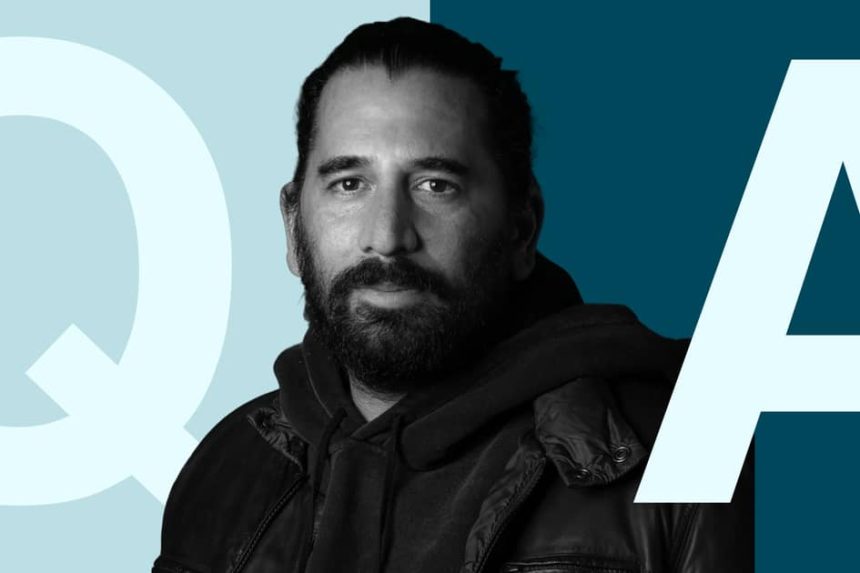
Dan Gardner is the co-founder of Code and Theory. He’s set to speak at Marketing Brew’s upcoming event, The Art and Science of AI in Marketing, on February 25.
Ahead of the event, we caught up with him over email to hear how he and his teams use AI for social listening.
This interview has been edited for length and clarity.
How are you and your teams using AI today?
AI is now the baseline infrastructure for knowledge work. Writing, research, prototyping, summarizing, coding. That’s individual leverage. It makes people faster. The more profound shift is collective leverage.
The real opportunity, where teams earn their edge, is in collaborative intelligence. AI should elevate realignment, not replace it…AI can surface context, pressure-test ideas, synthesize inputs, and map dependencies, but humans still decide what matters.
The companies pulling ahead are thinking better together. They’re using AI to widen perspective and expose blind spots, not just eliminate effort.
The next shift reshapes how brands earn attention, making them compete for algorithmic inclusion as well as eyeballs. AI agents summarize content before people see it. Interfaces are evolving to be more conversational and predictive. Delegation overtakes browsing as the key vehicle for discovery. With these changes afoot, brands will need to design for human and machine interpretation simultaneously by harnessing data, real utility and contextual relevance.
If companies simply retrofit AI onto legacy marketing models, they’ll disappear inside intermediated experiences. Instead, they need to rethink engagement from first principles so that customer experience becomes adaptive and continuous and static storytelling evolves into a responsive value exchange.
Beyond its productivity-enhancing capabilities, AI is a distribution layer. It changes who controls attention, how trust is formed, and where value is captured.
The organizations that win will redesign collaboration and customer experience around this shifting paradigm. They will architect for what comes next.
What’s the best real-life application of AI you’ve seen in marketing?
The most meaningful applications rethink where attention lives rather than optimizing existing channels. A strong example of this is our work with JBL. We optimized for LLMs through YouTube videos, gift guides, and other content. To the consumer, it’s just good content, but it serves a more powerful function by appealing to the machines as well.
Think about it as intersecting flywheels. People now ask LLMs questions during discovery. That is where intent forms. They validate socially. That is where trust forms. They transact wherever it makes sense. That could be owned platforms or third-party environments. That is where value converts.
Those motions are happening simultaneously and constantly influencing one another. So the strategy is not channel-first. It is journey-synchronized. The questions surfaced by LLMs become live mini-briefs for creators. They reveal real language, real intent, real friction. That input shapes content that performs in two directions at once.
For humans, the output shows up in validation spaces like social platforms, communities, and cultural touchpoints. It builds credibility and resonance. For machines, that same output is structured and contextualized, so LLMs can retrieve it, understand it, and cite it. It increases relevance at the exact moment of inquiry. Then, that thinking is embedded where transactions happen, so the brand feels coherent from discovery through conversion.
The result is not just content distribution. It is an experience system that compounds. Each interaction feeds the next flywheel. Discovery informs validation, which strengthens transaction data, which sharpens future discovery. That is how you stay culturally relevant while also becoming machine legible. This strategy paid off with a big increase in sales of JBL products during the holidays.
Get marketing news you’ll actually want to read
Marketing Brew informs marketing pros of the latest on brand strategy, social media, and ad tech via our weekday newsletter, virtual events, marketing conferences, and digital guides.
At the same time, the rise of closed AI systems creates a parallel opportunity. As platforms intermediate more of the customer journey, differentiation shifts toward service. That means designing the brand as an agent that can continuously deliver value inside and outside its own platform. It should surface insights, provide utility, integrate into other ecosystems, and participate directly in decision flows. In closed systems, brands earn accurate representation. Outside of them, brands create distinct, service-driven value that can’t be abstracted away.
The advantage will go to companies that build infrastructure that performs inside AI-mediated discovery and service models that extend beyond it. In that model, the brand is not a place you visit, a product or a site. It’s an active participant in your workflow, decisions and ongoing experience.
There are plenty of proposed use cases for AI. Which applications are most promising to you? Which ones are least promising?
The most promising direction is not agent-based automation alone. It’s the realization that AI is no longer the constraint. The constraint used to be technical feasibility. Now it is imagination.
We’re in a moment where the sum of these technologies has pushed us into a new creative stratosphere, allowing us to redefine what “digital-first” means in people’s lives, what transformation actually looks like. We’re primed to reinvent how brands behave, show up and tell stories.
We can now design historically impossible experiences. Adaptive narratives. Participatory services. Living systems that evolve with context. Brands that move beyond campaigns into continuous value creation.
When AI is approached as infrastructure for imagination rather than a tool to wield or a feature to deploy, it becomes a catalyst for entirely new categories of value.
What role do you think the advertising industry can or should play in evaluating AI risks, ethics, and regulations?
AI’s risks aren’t abstract technology risks. They are brand risks. If misused, AI can create short-term performance gains, but unwittingly promote long-term fragility. Brands that overreach, misrepresent information, mishandle data, or automate without care may see temporary efficiency, but they also erode trust. At best, brands endure short-term turbulence, and at worst, they end up saddled with self-inflicted structural damage that’s difficult to reverse.
This is why AI should be treated as infrastructure, not as a feature or a marketing stunt. Infrastructure shapes how an organization operates and what it stands for. The conversation should revolve around defining the organization’s values and ensuring the technology reinforces them.
In that sense, AI plays a similar role to an influencer or public spokesperson. It represents the brand at scale and speaks on its behalf. If it misaligns with the brand’s principles, the consequences are visible and amplified. Designing systems that express integrity, transparency and respect for the customer is paramount.
There is also a broader narrative risk. Some argue that these tools signal the end of creativity. As a creative industry, the obligation is the opposite: to demonstrate what happens when imagination and technological power intersect. AI can expand access to creativity, not diminish it. It can unlock new forms of storytelling, participation and ways to bring ideas to life.
We have an opportunity to prove that creativity does not shrink in the presence of powerful tools. It evolves. When values are clear and imagination leads, AI becomes a force multiplier for meaning.
Read the full article here