


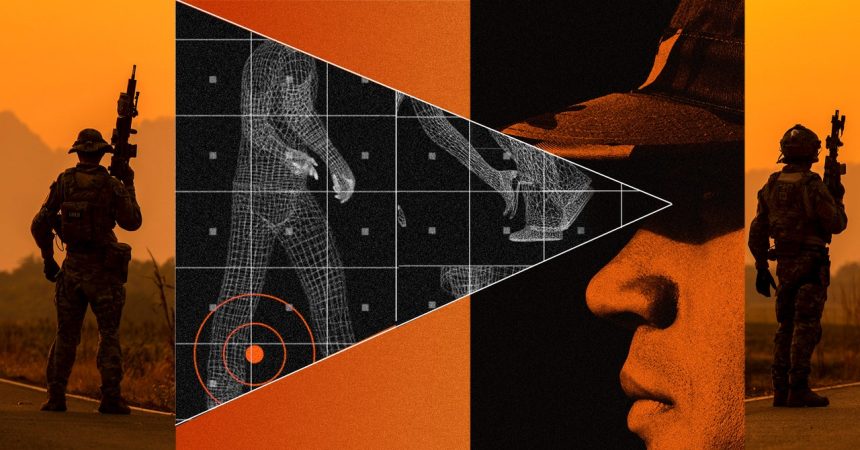
The day is slowly turning into night, and the American special operators are growing concerned. They are deployed to a densely populated urban center in a politically volatile region, and local activity has grown increasingly frenetic in recent days, the roads and markets overflowing with more than the normal bustle of city life. Intelligence suggests the threat level in the city is high, but the specifics are vague, and the team needs to maintain a low profile—a firefight could bring known hostile elements down upon them. To assess potential threats, the Americans decide to take a more cautious approach. Eschewing conspicuous tactical gear in favor of blending in with potential crowds, an operator steps out into the neighborhood’s main thoroughfare to see what he can see.
With a click of a button, the operator sees … everything. A complex suite of sensors affixed to his head-up display start vacuuming up information from the world around him. Body language, heart rates, facial expressions, and even ambient snatches of conversation in local dialects are rapidly collected and routed through his backpack supercomputers for processing with the help of an onboard artificial intelligence engine. The information is instantly analyzed, streamlined, and regurgitated back into the head-up display. The assessment from the operators’ tactical AI sidekick comes back clear: There are a series of seasonal events coming into town, and most passersby are excited and exuberant, presenting a minimal threat to the team. Crisis averted—for now.
This is one of many potential scenarios repeatedly presented by Defense Department officials in recent years when discussing the future of US special operations forces, those elite troops tasked with facing the world’s most complex threats head-on as the “tip of the spear” of the US military. Both defense officials and science-fiction scribes may have envisioned a future of warfare shaped by brain implants and performing enhancing drugs, or a suit of powered armor straight out of Starship Troopers, but according to US Special Operations Command, the next generation of armed conflict will be fought (and, hopefully, won) with a relatively simple concept: the “hyper enabled operator.”
More Brains, Less Brawn
First introduced to the public in 2019 in an essay by officials from SOCOM’s Joint Acquisition Task Force (JATF) for Small Wars Journal, the hyper-enabled operator (HEO) concept is the successor program to the Tactical Assault Light Operator Suit (TALOS) effort that, initiated in 2013, sought to outfit US special operations forces with a so-called “Iron Man” suit. Inspired by the 2012 death of a Navy SEAL during a hostage rescue operation in Afghanistan, TALOS was intended to improve operators’ survivability in combat by making them virtually resistant to small-arms fire through additional layers of sophisticated armor, the latest installment of the Pentagon’s decades-long effort to build a powered exoskeleton for infantry troops. While the TALOS effort was declared dead in 2019 due to challenges integrating its disparate systems into one cohesive unit, the lessons learned from the program gave rise to the HEO as a natural successor.
The core objective of the HEO concept is straightforward: to give warfighters “cognitive overmatch” on the battlefield, or “the ability to dominate the situation by making informed decisions faster than the opponent,” as SOCOM officials put it. Rather than bestowing US special operations forces with physical advantages through next-generation body armor and exotic weaponry, the future operator will head into battle with technologies designed to boost their situational awareness and relevant decisionmaking to superior levels compared to the adversary. Former fighter pilot and Air Force colonel John Boyd proposed the “OODA loop” (observe, orient, decide, act) as the core military decisionmaking model of the 21st century; the HEO concept seeks to use technology to “tighten” that loop so far that operators are quite literally making smarter and faster decisions than the enemy.
“The goal of HEO,” as SOCOM officials put it in 2019, “is to get the right information to the right person at the right time.”
To achieve this goal, the HEO concept calls for swapping the powered armor at the heart of the TALOS effort for sophisticated communications equipment and a robust sensor suite built on advanced computing architecture, allowing the operator to vacuum up relevant data and distill it into actionable information through a simple interface like a head-up display—and do so “at the edge,” in places where traditional communications networks may not be available. If TALOS was envisioned as an “Iron Man” suit, as I previously observed, then HEO is essentially Jarvis, Tony Stark’s built-in AI assistant that’s constantly feeding him information through his helmet’s head-up display.
Read the full article here