


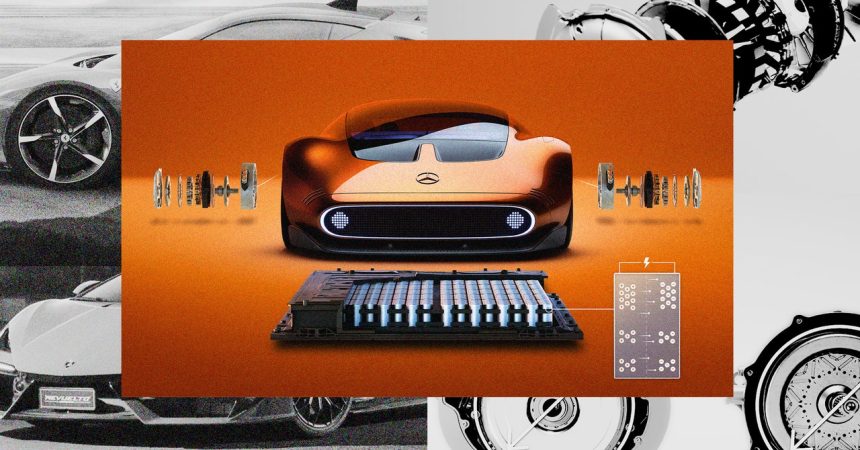
Car enthusiasts mourn the commoditization of propulsion. Once petrolheads would have chosen a BMW for its sonorous straight-six or a Mercedes-AMG for its thunderous V8. Now many believe that distinctiveness is rapidly diminishing. Electric cars might provide mad, silent thrust, but a common complaint is they are mostly indistinguishable for the character of their drivetrains.
Carmakers worry about this too. Their engineering DNA is less apparent in the EV age, leaving them more reliant on design, brand power, and other types of technology to differentiate their cars and keep their customers. There’s no point trying to trump the competition on power when the quickest Teslas and Lucids already have far more than you can ever deploy on the public road. More isn’t better when you already have too much.
But soon there’ll be a choice again: between the conventional radial-flux motors that have powered almost every EV until now and something radically different.
Axial-flux motors won’t necessarily offer more power, but they are so much lighter and smaller that their proponents say they have the potential to transform almost every other key measure of an EV’s performance—and the entire architecture of a car designed around them.
By fitting axial flux motors into the wheels, the spaces in a car’s body currently occupied by motors could be largely vacated, clearing the way for more batteries, people, or stuff, and permitting the sort of design exuberance that EVs have long promised but never quite delivered.
More importantly, this new design of motor might help address the growing public backlash against overweight, expensive EVs. They might reduce the weight of a typical EV by around 200 kilograms (440 pounds)—half in the motors themselves, and half from the mass-compounding effect which allows you to reduce the weight of other systems such as batteries and brakes as a result.
By sending mass into a virtuous downward spiral, carmakers could increase range, decrease cost, and perhaps even preserve the agile handling of lightweight cars, which enthusiasts also worry might disappear with the advent of the EV.
Flux Capacity
The principle isn’t new. The axial-flux motor was first demonstrated by Michael Faraday in 1821, but in the intervening two centuries nobody had figured out how to mass-produce one reliably.
British academic Tim Woolmer, however, likes a challenge. He devoted his Oxford PhD to designing the optimum motor for an electric car. An axial-flux motor would make more sense than the almost ubiquitous and easily mass-manufactured radial flux design, he decided. But not only had his chosen design barely made it out of the lab in nearly 200 years, there simply wasn’t a market for it when he started in 2005: GM’s EV1 had long been canned, and the Tesla Roadster was still three years away.
In an axial-flux “pancake” motor, the stator (the stationary part of an electric motor) and rotors are discs, sitting alongside each other less than a millimeter apart, the flux flowing through the stator axially or parallel with the shaft, and acting on the permanent magnets in the rotors on either side to turn them.
Read the full article here